
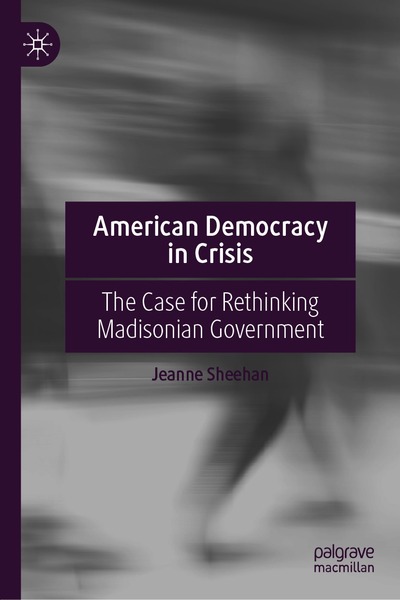
American Democracy in Crisis: The Case for Rethinking Madisonian Government, Jeanne Sheehan
-About this book
Public disenchantment with and distrust of American government is at an all-time high and who can blame them? In the face of widespread challenges—everything from record levels of personal and national debt and the sky high cost of education, to gun violence, racial discrimination, an immigration crisis, overpriced pharmaceuticals, and much more—the government seems paralyzed and unable to act, the most recent example being Covid-19.
It’s the deadliest pandemic in over a century. In addition to an unimaginable sick and death toll, it has left more than thirty million Americans unemployed. Despite this, Washington let the first round of supplemental unemployment benefits run out and for more than a month were unable to agree on a bill to help those suffering. This book explains why we are in this situation, why the government is unable to respond to key challenges, and what we can do to right the ship. It requires that readers “upstream,” stop blaming the individuals in office and instead look at the root cause of the problem. The real culprit is the system; it was designed to protect liberty and structured accordingly. As a result, however, it has left us with a government that is not responsive, largely unaccountable, and often ineffective. This is not an accident; it is by design. Changing the way our government operates requires rethinking its primary goal(s) and then restructuring to meet them. To this end, this book offers specific reform proposals to restructure the government and in the process make it more accountable, effective, and responsive.
Jeanne Zaino is Professor of Political Science and International Studies at Iona College, USA. She is the author of three previous books and appears regularly as a commentator in the national and international media. In addition to her teaching and research, she is currently serving as a political contributor at Bloomberg News.
Research in the field of political science stretches into an impressive number of areas, but it seems that most examines the personal aspects of governing. Perhaps it is human nature to want to connect a face to a problem, but much of the recent scholarship has focused on how individual actors or political groups have influenced American politics. In this wonderful book, Jeanne Zaino makes the compelling argument that much of our national frustration with gridlock, polarization, and low levels of political efficacy are the fault of the very.
Contents
Part I Choices
1 The Dispersion of Power: Choice I
Immigration, 2016, or Why It’s All About the Allocation of Power Of Governments and Power
The Impact of the Revolution and Articles on the Concentration of Power
Power Derived from the People
Implications and Ramifications, Benefits and Drawbacks
References
2 A Republic—If You Can Keep It: Choice II
Demos, Kratia, Kratos
The Limits of Direct Democracy: Problems of Scale, Exclusivity, and Knowledge
In Defense of Republican Democracy: Distrust and Esteem
A Limit of Republican Democracy: The Bouillabaisse of Ignorance
References
3 “Trias Politica”: Choice III
Requirement of Democracy?
‘Trias Politica [tp]’ I: The What
“tp” II: The Why—It’s All About Liberty
“tp” III: Of Nature and Roles
“tp” IV: The How
The Finger(s) versus the Moon
References
4 A Most Unsure Grip: Choice IV
The Executive Branch: On Which Neither Side Is Politically Adept
An Executive Must Be Provided: Madison’s Achilles Heel
“The Shyness of Gentlemen” Speaks Volumes: A Single or Plural Executive?
The Committee on Postponed Parts: Presidential Selection, Etc.
Things That Stagger I: Mode of Selection
Things That Stagger II: How Little Authority
References
Part II Paradoxes & Semi-Solutions
5 The Object of the Government or Systems Failure: Paradox I
The Object of Government: Protection of Liberty
Ambivalence Regarding the Goal of Government
Perpetual Stasis: The Great Paradox
References
6 A Necessary Evil: Paradox II and Semi-Solution I
The Baneful Effects of Party
An Unlikely Flashpoint: Hamilton and the Emergence of Organized Opposition
Out of a Series of Gropings: Jefferson, Madison, and The First Popular Party
An Enduring Solution?: The Difficulty of Joining “Ramshackle” Institutions
References
7 The Strategy of Majority Rule: Paradox III and Semi-Solution II
A Prudent, Temporizing, and Non-Violent Character: The Public Jefferson
Cooptation via Conciliation: Building a Moderate, Majority Governing Coalition, Part I
What is Practicable?: Building a Moderate, Majority Governing Coalition Part II
Limits of Influence: Bereft of His Leadership and Shorn of His Prestige
Ulysses bow of Leadership: The Limits of Leadership by Extra-Constitutional Means
References
8 A Failure to Act or What’s Most Remarkable: Paradox IV
Beyond the Lack of Knowledge: What’s Even More Remarkable
Toward an Operational Versus Aspirational Conception of Democracy
The Unappreciated Consequences of Inaction: “We Can’t Wait”
Failure to Produce: Is This Any Way to Run a “Good”
Republican Government?
What the System Has Wrought I: Wh’re Art Thee Power, Responsiveness, and Accountability?
What the System Has Wrought II: Give ___________ (I.e., Clinton, Bush, Obama, Trump, Etc.) a Break
What the System Has Wrought III: Flaky or Reliable (Depending on the Objective)
What the System Has Wrought IV: “the Goldilocks Problem”
References
Part III Remedies
9 Nothing Human Can Be Perfect: Constitutional Change and the Limits of the Remedies Thereafter
“An Easy, Regular and Constitutional Way” Lest They Resort to Violence
“It Ought to Be Hard, but Not That Hard”
“The Earth Belongs to the Living”: Jefferson v Madison
Incrementalism in Practice: A Story of Minimal Alterations to the Madisonian Structure
References
10 Restructuring by Rewriting or Toward a More Responsible Government: Remedies I (The What)
Attempts to Redesign the Constitution I: Story, Pendleton, Bradford, and Other Early Proponents
Attempts to Redesign the Constitution II: Wilson, Beyond Blind Worship
Attempts to Redesign the Constitution III: What to Do About the Evil Genius, Montesquieu or a Sample of “The What” (Remedies That Abound)
It’s Well Past the Time to “Do Better”
References
11 The “Two Modes”—Proposal by Congress and “The Other Way”: Remedies II (The How)
The Challenge of Realizing Reason-Based, Technical Change
Safety Valve I: The Regularized Mode—Congressional
Proposal
Valve I (Continued): The Graveyard of Structural Amendments
Safety Valve II: “The Other Way”—The Con-Con
Valve II (Continued): A “Pandora’s Box,” Parade of Horribles, Loose Cannon, Russian Roulette or The Bevy of Idioms Aroused by Talk of Another Con-Con
References
12 Return to First Solutions or Extra-Constitutional Means of Bridging the Divide: Remedies III (The How, Continued)
The Sky Is Falling: The Failure to Inspire the Masses and Other Reasons Structural Reform Has Been a Non-starter
The “P-” (As Opposed to the “S-”) Problem
Extra-Constitutional Means I: A Return to First Semi-Solutions—Responsible Parties and Leadership
Extra-Constitutional Means II: Electoral Reforms—Four Initiatives to Decrease Split-Ticket Voting
Extra-Constitutional Means III: Other Electoral Reforms Ideas—Changes via State Law and Party Rules
Extra-Constitutional Means IV: Institutional Reforms—Abolishing the Filibuster and Reconsidering the Veto Political Scientist as Advocate and Vice Versa
References
-caractéristiques
date de parution :3 janvier 2021
Éditeur : Springer
Langue : Anglais
NB.de pages : 280 pages
ISBN-10 : 3030622800
ISBN-13 : 978-3030622800
Poids de l’article : 539 g
Dimensions : 15.88 x 2.54 x 22.23 cm


Reviews
There are no reviews yet.