
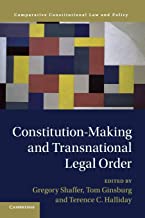
Constitution-Making and Transnational Legal Order,GREGORY SHAFFER, TOM GINSBURG, TERENCE C. HALLIDAY
-About this book
This book applies the theoretical framework of Transnational Legal Orders( TLOs) to the study of constitutional norms to assess what the TLO framework can help reveal for the analysis of, and engagement with, constitution-making and practice, and how the study of constitution-making can inform TLO theory.
The TLO framework brings together three concepts:
(i) it focuses on the issue of order, a central concept in the sociology of law regarding the creation and settling of generalized normative behavioral expectations;
(ii)it studies the role of law in such ordering processes, involving the use of legal form and legal institutions; and
(iii) it examines the transnational nature of the normative ordering.
Bringing these three concepts together, it defines a transnational legal order as
“a collection of formalized legal norms and associated organizations and
actors that authoritatively order the understanding and practice of law across
national jurisdictions”.
That legal order could be the constitutional order itself, or it could be legal norms included within constitutions, such as human rights, women’s rights, minority rights, property rights, religion, and so forth. In the latter case, a single constitution can comprise norms that are part of multiple TLOs.
The book reveals how these norms and patterns are rhetorically constructed.
For example, there are core norms in a liberal, democratic constitutional
prototype addressed by Scheppele and Landau. Similarly, there are central features pushed by a socialist TLO, such as existed in the Soviet era, and in Bolivarian constitutions involving different transnational networks (as discussed in the chapter by Law).
Taking the chapters together, the book investigates the extent to which we see moves either toward the transnational emergence of a single constitutional TLO; or to rival liberal and socialist constitutional TLOs; or to multiple, competing TLOs addressing distinct sub-issues; or to insurgent TLOs, such as the authoritarian one addressed by Scheppele and Landau that takes a liberal form, but compromises liberal norms.
-Contents
Constitution-Making as Transnational Legal Ordering
Tom Ginsburg, Terence C. Halliday, and Gregory Shaffer
1
2. Constitutional Advice and Transnational Legal Order
Tom Ginsburg
26
3. A Transnational Actor on a Dramatic Stage – Sir Ivor Jennings
and the Manipulation of Westminster Style Democracy
in Pakistan
H. Kumarasingham
55
4. Constitutions in World Society: A New Measure
of Human Rights
Colin J. Beck, John W. Meyer, Ralph I. Hosoki, and Gili S. Drori
85
5. Constitutional Dialects: The Language of Transnational Legal
Orders
David S. Law
110
6. Transnational Constitution-Making: The Contribution
of the Venice Commission on Law and Democracy
Paul Craig
156
7. Autocracy under Cover of the Transnational Legal Order
Kim Lane Scheppele
188
8. Democratic Erosion and Constitution-Making Moments:
The Role of Transnational Legal Norms
David E. Landau
234
9. The Possibilities and Limits of a Constitution-Making
Transnational Legal Order: The Case of Chile
Javier Couso
265
10. Participatory Constitution-Making as a Transnational
Legal Norm: Why Does It “Stick” in Some Contexts
and Not in Others?
Abrak Saati
283
Index 312
-carectéristiques
Date de parution :17 septembre 2020
Poids de l’article : 449 g
N.de pages : 334 pages
ISBN-13 : 978-1108460989
Dimensions: 15.24 x 2.54 x 22.23 cm
Éditeur : Cambridge University Press
Langue : Anglais




Reviews
There are no reviews yet.