
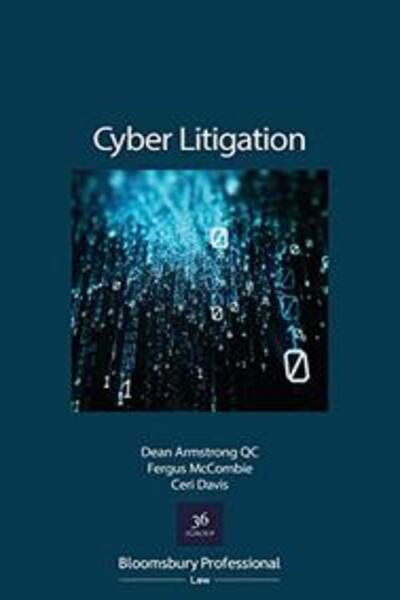
cyber Litigation: The Legal Principles by Dean Armstrong QC, Fergus McCombie, Ceri Davis
-About this book
Cyber Litigation: The Legal Principles brings together the existing legal principles in this rapidly developing area of law whilst at the same time considering the latest challenges facing practitioners and corporate advisers.
The authors have surveyed the legal landscape to identify bespoke approaches to the issues involved.
The book looks at the most common causes of action in cyber litigation, including ‘cybercrime’, IP, data protection breaches, and conflict of laws considerations. It analyses the situations where cyber-related litigation requires a new approach and looks at the remedies available. It covers cyber litigation and regulatory enforcement action, as well as alternatives to litigation such as the NCA Prevent scheme, Deferred Prosecution Agreements and Civil Recovery. It describes situations where arbitration or mediation are mandated, as well as online dispute resolution and technology powered alternatives to traditional determination.
Readers will benefit from the use of flowcharts, tables, checklists and case studies to provide a clear understanding of the processes involved, as well as legal analysis of significant cases, an insight into what constitutes ‘data’, and legal analysis and commentary on potential legal arguments that may arise in cyber litigation.
Cyber Litigation: The Legal Principles is an essential title for all practitioners involved in commercial disputes, information technology professionals, data protection officers, compliance staff and technologists with a legal interest.
-Contents
Preface v
Table of statutes xiii
Table of statutory instruments xix
Table of cases xxi
PART I INTRODUCTION
Chapter 1: What is Cyber Litigation? 3
What is cyber litigation? 3
What are the technologies that affect litigation? 4
What areas of society are affected by cyber litigation? 5
What are the current areas of cyber litigation? 6
Cyber litigation in practice 7
PART II CAUSES OF ACTION
Chapter 2: Cyber Litigation and Criminal Law 11
Introduction 11
Cyber-enabled or cyber-assisted? 12
What cyber-assisted crimes is technology giving rise to? 13
Domestic violence and domestic abuse 13
Harassment and public order 21
Voyeurism 31
Indecent photographs and prohibited images of children,
and extreme pornographic images 34
Financial crime: fraud, bribery and corruption, money laundering,
terrorist financing and financial sanctions 45
Illicit items 59
Theft 59
Blackmail 63
Trade sanctions and export controls 66
Murder and grievous bodily harm 72
What are the cyber-dependent crimes? 77
Ransomware, malware, spyware etc 77
Distributed denial-of-service 82
Cybercrime-as-a-service 84
What is technology doing to criminal investigations and the
criminal justice system? 84
Investigations 85
Evidence 95
Decision making 100
Chapter 3: Cyber Litigation and Civil Law 109
Cybersecurity 109
Contract and tort 109
Other sources of cybersecurity law 111
The regulation of online content 115
Age Appropriate Design Code 115
Online Harms White Paper 117
Select Committee Report on Immersive and Addictive Technologies 118
Particular types of online harm 119
Excessive screen time 119
Problem gaming 120
Online age ratings 121
‘Loot boxes’ and in-game purchases 121
E-sports 125
Development of automated vehicles 125
The policy context 125
Testing of automated vehicles 127
The legal issues 128
Artificial intelligence and databases 130
Financial technology 133
Algorithmic trading 134
Crowdfunding 135
Cryptoassets and smart contracts 136
Definitions and characteristics 136
Cryptoasset regulation 137
Smart contracts 140
Chapter 4: Causes of Action in Data Protection Law 143
Introductory 143
General Data Protection Regulation 143
Supervisory authorities 144
Scope and boundaries of data protection law 145
Territorial scope 145
The application of the GDPR 146
The role of the DPA 2018 148
Terminology and definitions 148
Personal data 148
Processing 151
Controller 152
Processor 152
Consent 152
Special categories of personal data 153
Profiling 153
Filing system 154
Pseudonymisation 155
Data protection principles 155
(a) ‘Personal data shall be processed fairly and lawfully and in a
transparent manner’ 156
(b) ‘Personal data shall be collected for specified, explicit and
legitimate purposes and not further processed in a manner
that is incompatible with those purposes …’ 163
(c) ‘Personal data shall be adequate, relevant and limited to what
is necessary in relation to the purposes for which it is
processed’ 164
(d) ‘Personal data shall be accurate and, where necessary kept up
to date. Every reasonable step must be taken to ensure that
personal data that is inaccurate, having regard to the purposes
for which it is processed, is erased or rectified without delay’ 164
(e) ‘Personal data shall be kept in a form which permits
identification of the data subjects for no longer than is
necessary for the purposes for which it is processed …’ 165
(f) ‘Personal data shall be processed in a manner that ensures
appropriate security of the personal data …’ 165
Accountability 166
Controller to processor contracts 166
Notification and registration requirements 168
Other accountability measures 168
Data subject rights 170
Rights of transparency and information 170
Subject access requests 171
The right of rectification 171
The right of erasure and the right to be forgotten 173
Right to restriction of processing 175
Data portability 176
Right to object, and automated decision-making 177
Data security and personal data breaches 178
PART III LITIGATION AND EVIDENCE
Chapter 5: Jurisdiction 183
Introduction 183
What are the general rules on jurisdiction in cyber litigation? 183
How can the general rules on jurisdiction be amended? 191
What are the particular areas of cyber litigation that have specific jurisdictional considerations? 197
New Court List and Pre-Action Protocol for Data Claims 203 Privacy Shield 204
How will the rules on jurisdiction be impacted by Brexit? 206
Chapter 6: Class Actions 209
Introduction 209
Group Actions in England and Wales 210
Consolidation of claims and multiparty litigation 210
Representative parties 210
Group Litigation Orders 212
Group Actions in cyber cases 214
GLOs 214
Representative actions 217
The future of group actions in cyber litigation 224
A new attitude from the courts? 224
Loss of control extended? 225
A growth in Group Actions? 227
Chapter 7: Vicarious Liability 229
Introduction 229
Vicarious liability 229
The Mohamud case 232
The Morrisons case 235
Vicarious liability and cyber litigation 246
What can companies and corporates do to protect themselves? 248
Chapter 8: Evidential Considerations 253
Introduction 253
What are the specific challenges in evidence gathering in cyber litigation? 254
Lawfully obtaining electronic material 254
Privacy 276
Evidence abroad 280
What are the specific evidential challenges once material has been obtained? 284
Maintaining the integrity of material 284
Accessibility of material 285
Admissibility of material 287
Retention of material 292
PART IV REMEDIES AND ALTERNATIVES TO LITIGATION
Chapter 9: Remedies 297
Introduction 297
What criminal remedies are likely to be seen in criminal ‘cyber’ cases? 297
Restraint and confiscation orders 298
What civil remedies are being seen in civil ‘cyber’ cases? 305 Injunctions 305
Legal considerations 320
Practical considerations 322
Contract law remedies 329
What remedies are provided by ‘regulators’ in ‘cyber’ cases? 331
Notice and take down requests 331
Information Commissioner’s Office 332
Should the courts and regulators develop new remedies for cyber litigation? 344
Chapter 10: Alternatives to Litigation 347
Introduction 347
What are the alternatives to criminal prosecutions in ‘cyber’ cases? 347
National Cyber Crime Unit’s Prevent programme 347
Serious Crime Prevention Orders 349
Deferred Prosecution Agreements 355
Civil recovery 360
Criminal taxation 367
What are the alternatives to civil actions in ‘cyber’ cases? 368
‘Cyber’ disputes being resolved by alternative dispute resolution 371
Information security in alternative dispute resolution procedures:
the 2020 Cybersecurity Protocol for International Arbitration 377
How are ordinary disputes being resolved by ‘cyber’ and technology? 379
Online dispute resolution 379
Alternatives to traditional dispute resolution 382
Index
-Caractéristiques
Date de parution :15 décembre 2020
Éditeur : Bloomsbury Professional
Langue : Anglais
NB.de pages : 440 pages
ISBN-10 : 1526513595
ISBN-13 : 978-1526513595
Poids de l’article : 708 g
Dimensions : 16.41 x 2.41 x 24.79 cm


Reviews
There are no reviews yet.