
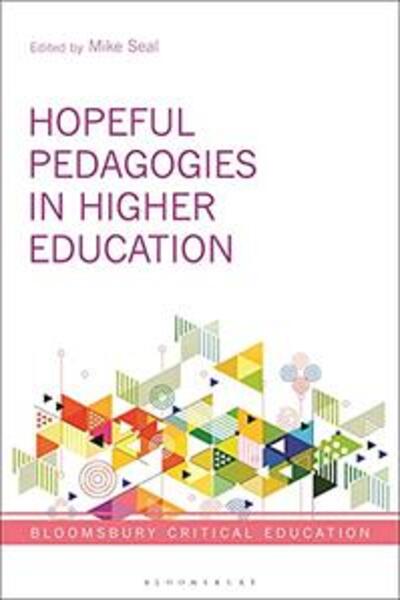
-About this book
Many accounts of critical pedagogy, particularly accounts of trying to enact it within higher education (HE), express a deep cynicism about whether it is possible to counter the ever creeping hegemony of neo-liberalism, neo- conservatism and new managerialism within Universities. Hopeful Pedagogies in Higher Education acknowledges some of these criticisms, but attempts to rescue critical pedagogy, locating some of its associated pessimism as misreading of Freire and offering hopeful avenues for new theory and practice. These misreadings are also located in the present, in the assumption that unless change comes within the lifetime of the project, it has somehow failed. Instead, this book argues that a positive utopianism is possible.
Present actions need to be celebrated, and cultivated as symbols of hope, possibility and generativity for the future – which the concept of hope implies. The contributors make the case for celebrating the pedagogies of HE that operate in liminal spaces – situated in the spaces between the present and the future (between the world as it is and the world as it could be) and also in the cracks that are beginning to show in the dominant discourse.
-Contents
Acknowledgements xix
Introduction: Are Hopeful Pedagogies Possible in Higher Education? 1
Part I Key Ideas and the Conceptual and Policy Terrain 15
1-Key Concepts in Critical Pedagogy: How We Teach Mike Seal, Response from Alan Smith 17
2-Critiques of Critical Pedagogy: The Post-critical Leoarna Mathias and Mike Gilsenan, Response from Joris Vlieghe 28
3-Perspectives on the Possibility of Hopeful Critical Pedagogies within
Higher Education Mike Seal, Response from Stephen Cowden 37
4-The Policy Context of Higher Education: Resistance Is Possible
Sarah Parkes and Jane Beniston, Response from Neil M. Speirs 48
5-The Pedagogy of Partnership John Peters and Leoarna Mathias, Response
from Mike Neary 59
Part II Hopeful Pedagogies in Higher Education 75
Part II A Hopeful Pedagogy within Courses 76
6- Early Years to Higher Education: Legacy and the Creation and
Connection of Hopeful Spaces Julie Boardman and Jane Beniston,
Response from Carol Aubrey 77
7- Widening the Cracks: Co-constructing Learning within Dialogical
Spaces Jane Beniston and Debbie Harris, Response from Dr László Varga 86
8 -Preparing for an Unexpected Journey: Exploring the Experience of
Teaching Critical Pedagogy through Critical Pedagogy Helen Bardy and Mike Gilsenan, Response from Christine Smith 97
9- Academic Identities: Conversations across the Cracks Roger Willoughby
and Parminder Assi, Response from Marina Tornero Tarragó 108vi Contents
Part II B Hopeful Pedagogies within Structures 117
10- The ‘Rehearsal Space’: Viewing Induction and Transition Work as a
Critical Pedagogy Practice Leoarna Matthias and Sarah Parkes, Response
from Liz Thomas 118
11- ‘Very Much a Democratic Thing’: Enacting the Pedagogy of Partnership Leoarna Mathias and John Peters, Response from Gill Gilbert 128
12- Foundation Years: Undoing Discourses of Deficit Pheobe Hall, Kace
McGowan, Leoarna Mathias, Samantha Snelleksz, Sarah Parkes and
Mike Seal, Response from Sarah Hale 137
Part II C Becoming the Hopeful Pedagogue 149
13- A Mindful Journey: Person-centred and Contemplative Critical
Approaches to Higher Education Ruth Roberts, Response from Luca Tateo 150
14 Rethinking Critical Pedagogy in Higher Education through a Psychosocial Lens Pete Harris, Response from Jo Trelfa 161
15- It’s Been Emotional: Exploring the Emotional Impact of Critical Pedagogy Practice with Non-traditional Students Pauline Grace,
Lorna Morgan and Adellah Snape, Response from Fin Cullen 171
Part II D Hopeful Pedagogies in the Spaces In-between 179
16- Sit Down Next to Me: Reflections on Academic Advising and Pedagogical Love Peter Sharpe, Response from Stephen Cowden 180
17- Pushing at an Open Door Tina McLoughlin 188
18- Quality Assurance or Assured Silence? Lorraine Loveland-Armour,Response from Seán Bracken 194
Part II E Hopeful Pedagogies beyond the Institution 207
19 -University as Community: Breaking the Circle of Certainty Tina McLoughlin, Lea Randolf and Mike Seal, Response from Simone Helleren 208
20-College-Based Higher Education: A New Hope John Keenan and Karima Kadi-Hanifi, Response from Paula McElearney 220
Conclusion: Hopeful Pedagogies Are Possible in Higher Education 228
References 241
Index 276
-Caractéristiques
Date de parution:17 juin 2021
Éditeur : Bloomsbury Academic
Langue : Anglais
NB.de pages : 320 pages
ISBN-10 : 135011653X
ISBN-13 : 978-1350116535
Poids de l’article : 617 g
Dimensions : 15.6 x 1.91 x 23.39 cm


Reviews
There are no reviews yet.