
NEW MEDIA AND REVOLUTION RESISTANCE AND DISSENT IN PRE-UPRISING SYRIA,BILLIE JEANNE BROWNLEE
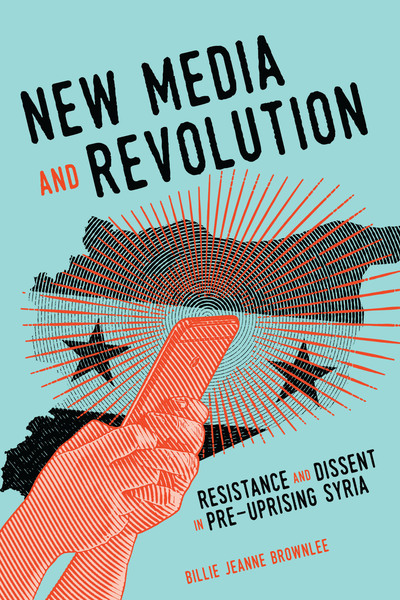
-About this book
The underlying argument of this book is that during the decade leading up to the uprising in Syria, a silent, localised form of resistance emerged as a result of contextual factors (economic, institutional, and social conditions, otherwise referred to as ‘opportunity structures’), conditioned by people’s access to the new media. The new media became the ‘mobilising structures’ of Syria’s pre-uprising social movement, the tools that changed people’s access to information and encouraged civic engagement in a period of structural frictions and social ferment.
This book argues that what Bayat defines as ‘street politics’, the physical and social space of the ‘street’, where citizens confront the authorities, has moved from the pavements and public spaces of the city to the virtual alleys of the Internet.
This is particularly significant in authoritarian contexts like the Syrian one, in which, although motives for popular mobilisation already existed before the emergence of the new information technologies, it was only through the Internet that people found a space in which to breach norms of social engagement and articulate their acts of protest and dissent. Satellite TV and the Internet dismantled the atomization of society, which the regime had created through decades of repressive rule.
Through the new media, people discovered ‘new geographies of protest’, where they could exercise what Bayat defined as the ‘art of presence’, meaning imposing their scenic presence, confronting the authorities, exposing the state’s wrongdoings, and more importantly forming collective subjectivities that did not exist before.
As a result of Syria’s online mobilisation, an unstructured expression of ‘everyday forms of resistance’ became a social movement per se, in the form of the uprising of 2011, when the actors involved became aware of their shared grievances and articulated their actions into a wider plan, which they hoped would be long-lasting, aimed at social transformation.
How does the scholarly community account for the extensive reliance of Syrian protesters on the new media at the time of the uprising, when the country was depicted as backward in terms of international and regional standards of media development? Did Syrians learn overnight how to use the new technologies?
This study understands the development of civic activism as having occurred as a result of a combination of endogenous and exogenous causes: institutional reforms, the engagement of civil society, and the influence of international media development aid.
In the build-up to the uprising in Syria, media assistance projects empowered a new generation of citizen journalists and activists tasked with widening the horizon of its citizens, holding the state responsible for its actions, and encouraging forms of civic engagement.
Oddly enough, media development aid is a mechanism that has largely been sidelined by the scholarly community, despite it having been implemented in many other parts of the world since the Second World War.
With the emergence of the new media technologies, Western powers have increased their foreign aid investment in this sector for purposes that are arguably going beyond a mere humanitarian response to resemble more the characteristics of ‘soft power’
Finally, this book does not dwell only on the Syrian context but draws comparative lines with the Arab Spring phenomenon and its local ecologies of protest, and with its global counterparts that in the past decade have seen citizens empowered by new media technologies in their struggle against authoritarian rule, economic austerity, and social inequality.
-Contents
Figures and Tables
Acknowledgements
1 New Media, New Battlefields for New Revolutions
2 From Virtual to Tangible Civic Mobilisation
3 ‘Change within Continuity’: The Lion Cub’s Reforms
4 Empowering Publics: Satellite TV and the Internet
5 Media Development and Foreign Aid Assistance
6 The Syrian Media Landscape after 2011
Conclusions – Media: Weapons of the Weak or the Weapons of Mass Distraction?
Notes
References
Index
-carectérstiques
Date de parution :16 juillet 2020
Poids de l’article : 454 g
N.de pages : 296 pages
ISBN-13 : 978-0228000891
Dimensions: 15.24 x 2.29 x 22.86
Éditeur : McGill-Queen’s University Press
Langue : Anglais


Reviews
There are no reviews yet.