
Pirate Lands,Governance and Maritime Piracy,URSULA DAXECKER AND BRANDON PRINS
-About this book
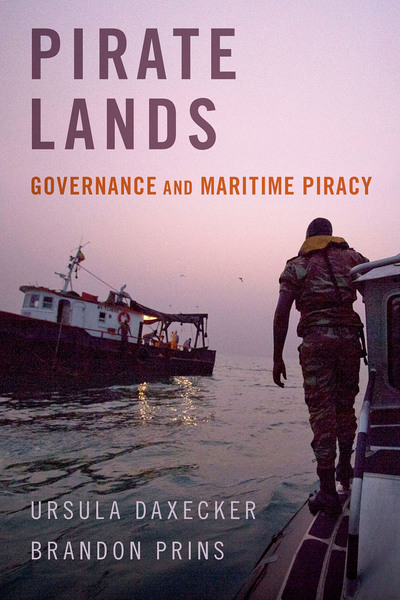
Maritime piracy’s improbable re-emergence following the end of the Cold War was surprising as the image of pirates evokes masted galleons and cutlasses. Yet, the number of incidents and their intensity skyrocketed in the 1990s and 2000s off of the coasts of Indonesia, Malaysia, the Philippines, India, Bangladesh, Nigeria, and Somalia.
As Ursula Daxecker and Brandon Prins demonstrate in Pirate Lands, Maritime piracy-like civil war, terrorism, and organized crime-is a problem of weak states. Surprisingly, though, pirates do not operate in the least governed areas of weak states. Daxecker and Prins address this puzzle by explaining why some coastal communities experience more pirate attacks in their vicinity than others.
They find that pirates do well in places where elites and law enforcement can be bribed, but they also need access to functioning roads, ports, and markets. Using statistical analyses of cross-national and sub-national data on pirate attacks in Indonesia, Nigeria, and Somalia, Daxecker and Prins detail how governance at the state and local level explain the location of maritime piracy. Additionally, they employ geo-spatial tools to rigorously measure how local political capacity and infrastructure affect maritime piracy.
Drawing upon interviews with former pirates, community members, and maritime security experts, Pirate Lands offers the first comprehensive, social-scientific account of a phenomenon whose re-appearance after centuries of remission took almost everyone by surprise.
CONTENTS
Preface
List of abbreviations
1. Introduction
PUZZLE AND ARGUMENT IN BRIEF
MARITIME PIRACY AND THE STUDY OF TRANSNATIONAL CRIME
LIMITATIONS OF EXISTING WORK
HOW GOVERNANCE MATTERS FOR PIRACY
EMPIRICAL APPROACH
PLAN OF THE BOOK
2. Maritime Piracy, Past and Present
CONDITIONS DRIVING MARITIME PIRACY
Political Violence
Privation
Geographic Opportunity
State Capacity and Governance
COUNTER-PIRACY CHALLENGES AND OPPORTUNITIES
CONCLUSION
3. Theoretical Framework
WEAK STATES, GLOBAL ORDER, AND OPPORTUNITIES FOR PIRACY
Strong, Weak, and Failed States
State Capacity in Postcolonial States
Post–Cold War Challenges to State Capacity and the Re-emergence of Piracy
How Weak National Capacity Enables Piracy
LOCAL GOVERNANCE AND PIRACY IN WEAK STATES
All Governance Is Local
Local Governance and Crime
How Local Governance Matters for Piracy
EXTENSIONS: LOCAL GOVERNANCE AND PIRACY IN FAILED AND STRONG STATES
Failed States
Strong States
CONCLUSION
4. Describing Contemporary Maritime Piracy
PIRATES AND THEIR ORGANIZATIONS
DESCRIBING PIRATE ACTIVITY
Defining Piracy
Maritime Piracy Event and Location Dataset (MPELD)
Patterns in Maritime Piracy
The Correlates of Piracy
Political Violence
Economic Grievance
Geography and Climate
State Capacity
CONCLUSION
5. National State Capacity and Maritime Piracy
RESEARCH DESIGN
Data and Dependent Variable
Independent Variables
Control Variables
RESULTS
ROBUSTNESS TESTS
FROM NATIONAL TO SUBNATIONAL CAPACITY
Identifying Appropriate Subnational Units
Nighttime Light Emissions as Subnational Capacity
Capacity, Density, or Development?
CONCLUSION
6. Governance and Piracy in Indonesia
HISTORICAL BACKGROUND
QUANTITATIVE ANALYSIS
Data and Units of Analysis
Dependent Variable and Estimation Method
Independent Variable: Nighttime Lights as Subnational State Capacity
Validation of Nighttime Lights in Indonesia
Control Variables
RESULTS
ROBUSTNESS TESTS
QUALITATIVE EVIDENCE FROM FIELDWORK IN THE RIAU ISLANDS
Background on the Riau Islands
Access to Markets and Piracy
Collusion and Piracy
How Improvements in Local Governance Reduce Incentives for Piracy
CONCLUSION
7. Governance and Piracy in Nigeria and Somalia
NATIONAL GOVERNANCE AND PIRACY IN NIGERIA AND SOMALIA
LOCAL GOVERNANCE AND PIRACY IN NIGERIA AND SOMALIA
Probing the Mechanisms
Infrastructure, Markets, and Collusion in Nigeria
Infrastructure, Markets, and Collusion in Somalia
Testing the Subnational Relationship
RESEARCH DESIGN
Dependent Variable and Estimation Method
Independent Variable: Nighttime Lights as Subnational Capacity
Validation of Nighttime Lights
Control Variables
RESULTS
CONCLUSION
8. Conclusion
WHAT WE HAVE LEARNED
EXTENSIONS BEYOND MARITIME PIRACY
Local Governance and Other Crime
Maritime Piracy and Diffusion
Maritime Piracy and Political Violence
IMPLICATIONS FOR COUNTER-PIRACY OPERATIONS
WHAT TO EXPECT
Appendix A. Maritime Piracy Event and Location Dataset (MPELD) Codebook
Appendix B. Additional Materials for Chapter 4
PIRACY DATA COMPARISONS
TRADE ROUTES AND PIRACY
STATE CAPACITY
Appendix C. Additional Materials for Chapter 6
EXTRACTIVE CAPACITY AND PIRACY
VALIDATION OF NIGHTTIME LIGHTS
ALTERNATIVE UNITS OF ANALYSIS: LAND GRID CELLS
ALTERNATIVE OPERATIONALIZATION OF CAPACITY: POLICE STATIONS
DIFFERENT TYPES OF PIRACY: HIJACKINGS AND VIOLENCE
QUALITATIVE EVIDENCE: RESPONDENT INFORMATION
QUALITATIVE EVIDENCE: INTERVIEW GUIDE
Appendix D. Additional Materials for Chapter 7
EXTRACTIVE CAPACITY AND PIRACY
QUALITATIVE EVIDENCE: RESPONDENT INFORMATION
VALIDATION OF NIGHTTIME LIGHTS IN NIGERIA AND SOMALIA
Bibliography
Index
-caractéristiques
Date de parution :1 mars 2021
Éditeur : OUP USA
Langue : Anglais
N.de pages : 264 pages
ISBN-10 : 0190097396
ISBN-13 : 978-0190097394
Poids: 788 g






Reviews
There are no reviews yet.