
Sovereignty Blockchain 1.0: Orderly Internet and Community with a Shared Future,Humanity by Lian Yuming
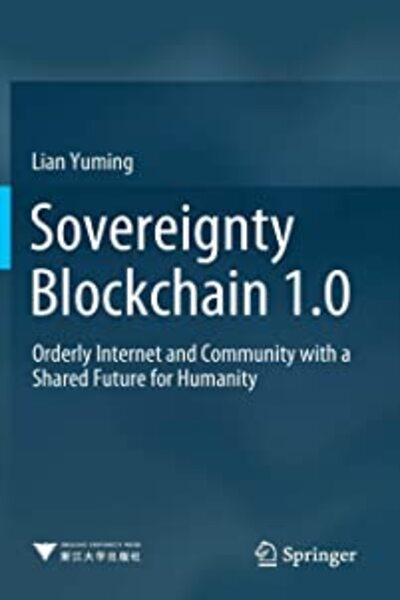
-About this book
This book presents a general framework analysis of sovereignty in blockchain based on the concept of blockchain technology, and specifically discusses the three theoretical foundations of sovereignty in blockchain: data sovereignty theory, social trust theory, and smart contract theory. It also explores the evolution of laws concerning data and digital rights, how to build trust mechanisms for digital rights transactions, as well as contract signing and the implementation of digital rights transactions.
Contents
1 Orderly Internet
1.1 The Evolution of the Internet
1.1.1 Internet of Information
1.1.2 Internet of Value
1.1.3 Orderly Internet
1.2 Relationship Between Data Force and Data
1.2.1 Data Evolution
1.2.2 Data Capital Theory
1.3 Data Game Theory
1.4 Sovereignty Blockchain
1.5 From Blockchain to Sovereignty Blockchain
1.6 From Unitary Dominance to Decentralized Co-governance
1.7 From Dependence on Objects to Dependence on Data References
2 Data Sovereignty Theory
2.1 Data Rights
2.2 Human Rights, Property Rights, and Data Rights
2.2.1 From Numbers to Data Rights
2.2.2 Definition of Data Rights
2.2.3 Distinctions Between Human Rights, Property Rights, and Data Rights
2.3 Private Rights, Public Power, and Sovereignty
2.3.1 Private Rights
2.3.2 Public Power
2.3.3 View of Sovereignty
2.4 Sharing Rights: Essence of Data Rights
2.4.1 Sharing Rights and Possession Rights
2.4.2 From “One Ownership for One Object”to “Multi-Ownership of Data”
2.4.3 Connotation of Sharing Rights
2.5 Data Sovereignty and Digital Human Rights
2.6 Differences Between Sovereignty and Human Rights
2.6.1 Tension and Conflict Between Sovereignty and Human Rights
2.6.2 Communication and Agreement Between Sovereignty and Human Rights
2.7 Human Rights of the Fourth Generation
2.7.1 The First Generation of Human Rights
2.7.2 The Second Generation of Human Rights
2.7.3 The Third Generation of Human Rights .
2.7.4 Digital Human Rights
2.8 Blockchain Reshapes Data Sovereignty
2.8.1 Re-Understanding Data Sovereignty
2.8.2 Sovereignty Under Blockchain
2.8.3 Data Sovereignty Under Blockchain
2.9 Data Sovereignty Game
2.10 Confrontation of Data Sovereignty
2.11 Transfer and Sharing of Data Sovereignty
2.12 Data Sovereignty, Data Security and Data Governance
2.12.1 Challenges and Countermeasures of Data Sovereignty
2.12.2 The Essence of Data Security: National Data Sovereignty
2.12.3 Data Governance Rises to National Strategy References .
Social Trust Theory
3.1 Trust and Consensus
3.2 Trust and Social Order
3.2.1 Trust and Reliance in an Acquaintance Society
3.2.2 Trust System in a Stranger Society
3.2.3 Trust Crisis in a Network Society .
3.3 The Consensus Mechanism of Blockchain
3.4 Trust is De-Trust
3.4.1 Centralization and Decentralization
3.4.2 De-Trust of Blockchain
3.4.3 Blockchain-Based Credit Society
3.5 Digital Trust Model
3.6 Model Theory and Trust Model
3.7 Hyperledger: From Traditional Bookkeeping to Everyone-To-Everyone Bookkeeping
3.8 Cross-Link Transmission: From Information Transmission to Value Transmission
3.9 Smart Contract: From Choice Trust to Machine Trust
3.10 Digital Currency and Digital Identity
3.11 Digital Currency
3.11.1 Hazards of Digital Currencies
3.11.2 Digital Currencies and Sovereignty Digital Currencies .
3.11.3 Sovereignty Digital Currency Under Sovereignty Blockchain
12 Digital Identity
3.12.1 From Traditional Identity to Digital Identity
3.12.2 Digital Identity and Destratification
3.12.3 Blockchain-Based Digital Identity
13 Digital Order ferences theory of Smart Contract
1 Trust Digital Economy
4.1.1 Blockchain Empowers Financial Technology (FinTech)
4.1.2 Smart Contract and Data Transaction
4.1.3 Trusted Digital Economy Ecosystem
2 Programmable Society
4.2.1 From Being Programmable to Cross-Terminal
4.2.2 Data, Algorithm, and Scenario
4.2.3 Digital Citizens and Social Governance
3 Traceable Government
4.3.1 The Regulation of Government Power
4.3.2 Traceability of Government Responsibility
4.3.3 Paradigm of Digital Government
references
5.community with a Shared Future for Humanity Based Sovereignty Blockchain
5.1 Human Destiny in Global Challenges
5.1.1 Future Global Challenges
5.1.2 Risks Behind “Grey Rhino” and “Black Swan”
5.1.3 The Gospel or Disaster of Artificial Intelligence
2 Governance Technology and a Community with a Shared Future for Cyberspace
5.2.1 Governance Technology and Governance Modernization
5.2.2 Three Pillars of Governance Technology
5.2.3 Cyberspace Governance Based on Sovereignty Blockchain
3 Tech for Social Good and Rule of Conscience
5.3.1 The Value Orientation of “Data Persons”
5.3.2 The Soul of Science
5.3.3 Cultural Significance of Yangming Philosophy
in Building a Community with a Shared Future for Humanity
Bibliography
-caractéristiques
Date de parution :8 mai 2021
Éditeur : Springer Verlag, Singapore
Langue : Anglais
NB.de pages : 232 pages
ISBN-10 : 9811607567
ISBN-13 : 978-9811607561
Poids de l’article : 531 g
Dimensions : 15.6 x 1.6 x 23.39 cm
-caractéristiques
Date de parution :8 mai 2021
Éditeur : Springer Verlag
Langue : Anglais
NB.de pages : 232 pages
ISBN-10 : 9811607567
ISBN-13 : 978-9811607561
Poids de l’article : 531 g
Dimensions : 15.6 x 1.6 x 23.39 cm


Reviews
There are no reviews yet.