
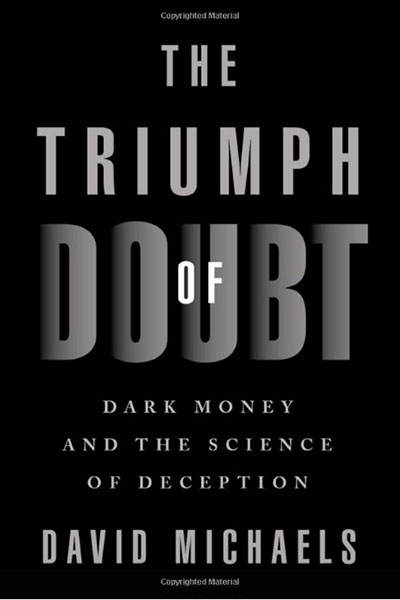
The Triumph of Doubt: Dark Money and the Science of Deception,David Michaels
-Résumé
This book is not about Deflategate. None of the episodes and issues I’ll discuss here are as trivial as the allegation that a celebrated quarterback may have cheated in a big football game. The subjects here are deadly serious (including a different NFL story: brain injuries). The knee-jerk behavior demonstrated by the NFL in Deflategate is pertinent only because it’s a notorious episode that vividly demonstrates the reach of an instinctive, systemic corporate behavior, one that flies mostly under the media’s and the public’s radar.
Rare is the CEO today who, in the face of public concern about a potentially dangerous product, says, “Let’s hire the best scientists to figure out if the problem is real and then, if it is, stop making this stuff.” In fact, evidence from decades of corporate crisis behavior suggests exactly the opposite. The instinct is to take the low road: deny the allegations, defend the product at all costs, and attack attack attack the science underpinning the concerns. Of course, corporate leaders and anti-regulation ideologues will never say they value profits before the health of their employees or the safety of the public. They’ll never say they care less about our water and air than environmentalists do. But their actions belie their rhetoric. Decision-makers atop today’s corporate structures are responsible for delivering short- and long-term financial returns, and in the pursuit of these goals a certain dissonance creeps in: profits and growth above all else. Avoidance of financial loss, to many corporate executives, is an alibi for just about any ugly decision.
Of course, decisions at the highest level are also not black-and-white or remotely simple. They’re dictated by factors such as the cost of possible government regulation, perhaps combined with loss of market share to less hazardous products. And, of course, the companies are afraid of being sued by people sickened by their products, which costs money and can result in serious damage to the brand. All of this is part of the corporate calculus.
I describe this corporate strategy as “manufacturing doubt,” or “manufacturing uncertainty.” My objective is to identify, characterize, and illuminate this strategy so readers can see exactly what these mercenary scientists and the firms that hire them are doing. In just about every corner of the corporate world, conclusions that might support regulation are always disputed. Studies in animals will be deemed irrelevant, human data are dismissed as not representative, and exposure data are discredited as unreliable. Always, there’s too much doubt about the evidence, not enough proof of harm, not enough proof of enough harm.
-CONTENTS
1. Introduction
2. The Science of Deception
3. The Forever Chemicals
4. The NFL’s Head Doctors
5. A Spirited Denial
6. The Deal with Diesel
7. On Opioids
8. Deadly Dust
9. Working the Refs
10. Volkswagen’s Other Bug
11. The Climate Denial Machine
12. Sickeningly Sweet
13. The Party Line
14. Science for Sale
15. Future in Doubt
Disclosures and Acknowledgments
Notes
Index
-caractéristiques
date de parution:9 avril 2020
Poids de l’article : 582 g
N de pages : 336 pages
ISBN-10 : 0190922664
Dimensions : 23.62 x 3.3 x 16.51 cm
Éditeur : Oxford University Press
Langue : Anglais


Reviews
There are no reviews yet.