
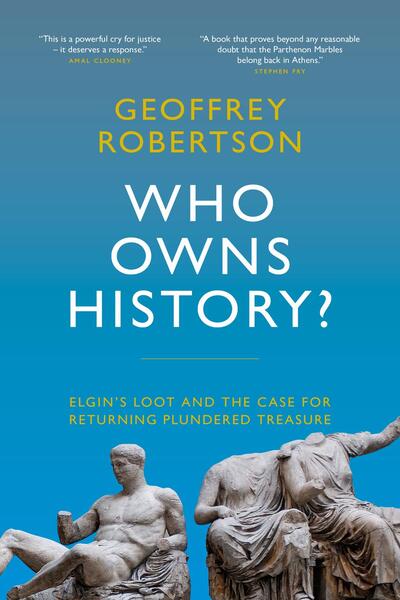
Who Owns History?: Elgin’s Loot and the Case for Returning Plundered Treasure by Geoffrey Robertson
-About this book
The biggest question in the world of art and culture concerns the return of property taken without consent. Throughout history, conquerors or colonial masters have taken artefacts from subjugated peoples, who now want them returned from museums and private collections in Europe and the USA.
The controversy rages on over the Elgin Marbles, and has been given immediacy by figures such as France’s President Macron, who says he will order French museums to return hundreds of artworks acquired by force or fraud in Africa, and by British opposition leader Jeremy Corbyn, who has pledged that a Labour government would return the Elgin Marbles to Greece. Elsewhere, there is a debate in Belgium about whether the Africa Museum, newly opened with 120,000 items acquired mainly by armed forces in the Congo, should close.
Although there is an international convention dated 1970 that deals with the restoration of artefacts stolen since that time, there is no agreement on the rules of law or ethics which should govern the fate of objects forcefully or lawlessly acquired in previous centuries.
Who Owns History? delves into the crucial debate over the Elgin Marbles, but also offers a system for the return of cultural property based on human rights law principles that are being developed by the courts. It is not a legal text, but rather an examination of how the past can be experienced by everyone, as well as by the people of the country of origin.
-CONTENTS
Preface
Chapter One: Whose History Is It?
Background
The Cultural Property Debate
The Right of States – and Peoples
Macron’s Challenge
The Marbles
A Human Rights Approach
Chapter Two: The Glory That Was Greece
A Brief Background
Building the Parthenon
Chapter Three: Elgin: Thief or Saviour?
The Acropolis Before Elgin
Lord Elgin’s Mission
The So-Called Firman
Elgin’s Motivation
An Ambassador’s Conflict of Interest
No Elgin, No Marbles?
Chapter Four: In the Keeping of the British Museum
The Select Committee
Lord Duveen and the Cleaning Scandal
To Russia Without Love
Elginisation
Chapter Five: The Case for Re-Unification
Demands for the Marbles After Greek Independence
The UK Refuses UNESCO Mediation
The Case for the Museum, Refuted
Chapter Six: International Law to the Rescue?
Conventions
State Practice
Case Law
Human Rights Law
War Law
Conclusion
Chapter Seven: Museums of Blood
Defining the Right of Return
The Benin Bronzes
The Rosetta Stone
The Bust of Nefertiti
The Maqdala Pillage
The Gweagal Shield
Priam’s Treasure
The Koh-i-Noor Diamond
Dahomey, 1892
The Old Summer Palace, Beijing
The Easter Island Moai
The Ashanti Wars
A Note on Replicas
Chapter Eight: Towards Justice
Restorative Justice
The UNESCO Convention and Its Limits
A Convention for the Repatriation of Important Cultural Heritage (CRICH)
Conclusion
Index
-Caractéristiques
Date de parution :5 novembre 2019
Éditeur : Biteback Publishing
Langue : Anglais
NB.de pages : 320 pages
ISBN-10 : 178590521X
ISBN-13 : 978-1785905216
Poids de l’article : 440 g
Dimensions : 15.3 x 2.7 x 24.1 cm


Reviews
There are no reviews yet.