
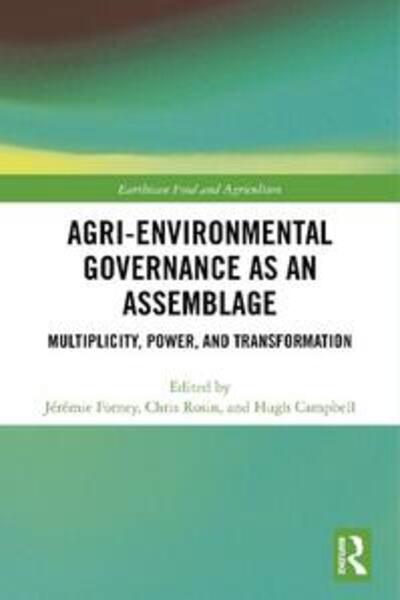
Agri-environmental Governance as an Assemblage: Multiplicity, Power, and Transformation, Jérémie Forney, Chris Rosin, Hugh Campbell
-About this book
In recent decades, the governance of the environment in agri-food systems has emerged as a crucial challenge. A multiplicity of actors have been enrolled in this process, with the private sector and civil society progressively becoming key components in a global context often described as neoliberalization. Agri-environmental governance (AEG) thus gathers a highly complex assemblage of actors and instruments, with multiple interrelations.
This book addresses this complexity, challenging traditional modes of research and explanation in social science and agri-food studies. To do so, it draws on multiple theoretical and methodological insights, applied to case studies from Asia, Europe, Africa, and the Americas. It elaborates an emergent approach to AEG practices as assemblages, looking at the coming-together of multiple actors with diverse trajectories and objectives. The book lays the foundations for an encompassing theoretical framework that transcends pre-existing categories, as well as promoting innovative methodologies, which integrate the role of social actors – including scientists – in the construction of new assemblages. The chapters define, first, the multiplicities and agencies inherent to AEG assemblages. A second set tackles the question of the politics in AEG assemblages, where political hierarchies interweave with economic power and the search for more democratic and participative approaches. Finally, these insights are developed in the form of assemblage practice and methodology. The book challenges social scientists to confront the shortcomings of existing approaches and consider alternative answers to questions about environmental governance of agri-food systems.
-Contents
Notes on contributors vii
1- Introduction: agri-environmental governance as assemblage 1
Jérémie Forney , Chris Rosin and Hugh Campbell
Part I :Assembling ontologies: multiplicities and agencies 17
2- Assembling payments for ecosystem services in Wales 19
Sophie Wynne – Jones and Thomas Vetter
3- Carolina dreamin’: a case for understanding farmers’ decision-making and hybrid agri-environmental governance
initiatives as complex assemblages 38
Caela O’Connell and Deanna L . Osmond
4- Killing two (or more) birds with one stone: the case of governance through multifunctionality payments in Japan 59
H aruhi koIba and Kiyohi koa kamoto
5- Assembling halloumi: contesting the EU’s food quality label policy in the Republic of Cyprus 76
G isela W elz
6- From ‘disciplinary societies’ to ‘societies of control’: an historical narrative of agri-environmental governance in Indonesia 91
Angga Dwiartama
Part II :The politics of territorialisation 105
7- Assembling value in carbon forestry: practices of assemblage,
overflows and counter-performativities in Ugandan carbon forestry 107
Adrian Nel
8- Not defined by the numbers: distinction, dissent and democratic possibilities in debating the data 127
Karly Burch , Katharine Legun and Hugh Campbell
9- Media, decentralization, and assemblage responses to water quality deterioration in Uruguay 145
Diego Thompson
10 -The “dirty dairying” campaign in New Zealand: constructing problems and assembling responses 161
Ismaël Tall and Hugh Campbell
11- Beyond soyisation: Donau Soja asassemblage 177
Dana Bentia and Jérémie Forney
Part III :Assemblage for building new AEG practices 193
12- The politics of big data: corporate agri-food governance meets “weak” resistance 195
M ichael Carolan
13- Assemblage and the epistemology of practice: imagining situated water governance 213
Ruth B eilin
Index 232
-Caractéristiques
Date de parution:31 mars 2021
Éditeur : Routledge
Langue : Anglais
NB.de pages : 248 pages
ISBN-10 : 0367508311
ISBN-13 : 978-0367508319
Poids de l’article : 354 g
Dimensions : 15.6 x 1.42 x 23.4 cm


Reviews
There are no reviews yet.