
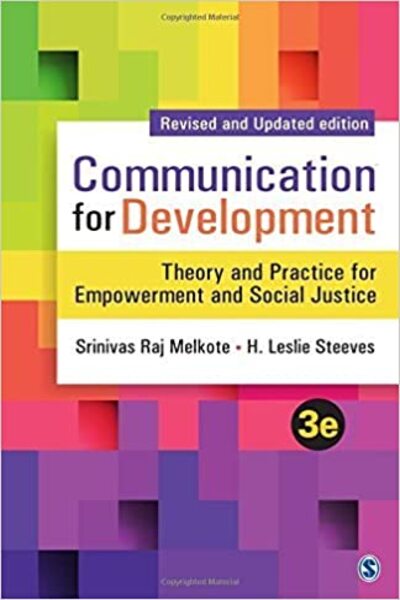
Communication for Development Theory and Practice for Empowerment and Social Justice,Srinivas Raj Melkote H. Leslie Steeves
-About this book
Watch Professor Melkote talk about Communication for Development: Theory and Practice for Empowerment and Social Justice
This book critically examines directed social change theory and practice while presenting a conceptual framework of development communication to address inequality and injustice in contemporary contexts.
This third edition features significantly revised and updated chapters to include the latest scholarship on, and practices of, media and communication for development. It explores empowerment and social justice to individuals and communities around the world in the context of increasing globalization. Tracing the history of development communication, it looks objectively at diverse approaches and their supporters, and goes on to provide models for the future. It also offers a new chapter presenting the authors’ framework foregrounding empowerment and social justice as goals for development communication in the 21st century.
The earlier editions of this book, Communication for Development in the Third World (1991 and 2001), are established core texts for courses on development communication throughout the world.
-CONTENTS
List of Abbreviations
Foreword by Late Dr Luis Ramiro Beltran Salmon
Preface
Part I:Introduction and Overview
- Development Communication, Empowerment, and Social Justice in the Globalization Epoch
Media and Communication
Development and Directed Change
Empowerment
Social Justice
Development Communication
Third World
Globalization
Conclusion
Organization of the Book
- Evolution of Devcom for Development and Social Justice
Evolution of the Theory and Practice of Devcom
Communication and Development for Social Justice in the 21st Century
Conclusion
Part II:Development Discourse, Modernization Theory, and Devcom
- Modernization, Globalization, and the Dominant Development Discourse
Modernization as an Economic Model
Modernization as Social Evolution
Modernization as Individual Change
Modernization as Discourse
Globalization
Conclusion
- Media and Communication in Modernization and Globalization
Communication Effects Approach
Mass Media and Modernization Approach
Diffusion of Innovations Research
Social Marketing
Family Planning and HIV/AIDS Communication Campaigns
Media and Communication under Globalization
Conclusion
Part III:Critical Perspectives on Communication and Development
- Deconstructing the Dominant Development Paradigm
Biases of the Dominant Development Paradigm Critique of the Economic Models
Sociological and Psychosocial Models Revisited
Gender and Environmental Biases in Modernization Discourse
Alternative Perspectives of Development and Social Change
Conclusion
- Critique of Devcom in the Dominant Paradigm
Critique of Mass Media under Modernization
Critique of Diffusion of Innovations Research and Practice
Critical Appraisal of Campaigns in Strategic Social
Change New Roles for Devcom
Digital Communication Technologies for Development
Conclusion
Part IV: Liberation Perspectives and Practices in
Development
- Liberation Theology and Development
Religious Bias in the Dominant Development Paradigm
Jewish Liberation Theology
Christian Liberation Theology
Islam and Liberation
Gandhian Liberation Theology
Buddhism and Liberation
Liberation Theology and Marxism
Forming Alliances
Conclusion
- Communication and Spirituality in Development
Paolo Freire and Liberation Theology
Base Ecclesial Community Movement in Brazil
Sarvodaya Shramadana Movement in Sri Lanka
Muslims’ Roles in United Nations Population Fund
Projects in Ghana
Conclusion
Part V Participatory and Empowerment Paradigms
for Social Justice
- Participatory Paradigm in Development
Participatory Strategies in Directed Social Change
Participatory Communication Processes and Strategies
Communication Models in Directed Change Programs
Enhanced Role for Devcom
Conclusion
- Media and Communication for Empowerment
Communication for Empowerment
Niche for DSC Professionals in the Empowerment Model
Conclusion
- Devcom for Empowerment and Social Justice
Critical Development Study
Alternatives to the Neoliberal Model of Directed Change
Devcom for Social Justice in Directed Change:
A Conceptual Framework
Conclusion
Postscript
Appendices
Appendix A: Historical Overview of Development/
Underdevelopment
Appendix B: Highlights of Media, Communication, and
Development Activities since World War II
Bibliography
Index
-caractéristiques
Date de parution :13 octobre 2015
Éditeur : SAGE Publications
Langue : Anglais
NB.de pages : 565 pages
ISBN-10 : 9351502570
ISBN-13 : 978-9351502579
Poids : 610 g
Dimensions : 13.97 x 3.61 x 21.59 cm


Reviews
There are no reviews yet.