
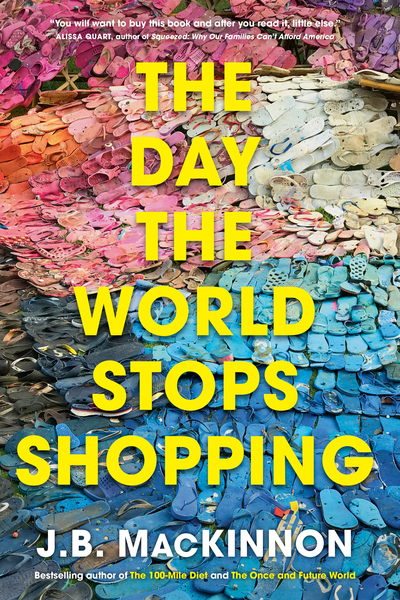
-About this book
In a brilliant work of imaginative non-fiction, prize-winning author J.B. MacKinnon asks what would happen—to our economy, our ecology, our products, our selves—if we stopped consuming so much? Is that alternative world one we might actually want to live in?
« We can’t stop shopping. And yet we must. This is the consumer dilemma. »
The planet says we consume too much: in North America, we burn the earth’s resources at a rate five times faster than they can regenerate. And despite our efforts to « green » our consumption—by recycling, increasing energy efficiency, or using solar power—we have yet to see a decline in global carbon emissions.
The economy says we must always consume more, because, as we’ve seen in the pandemic, even the slightest drop in spending leads to widespread unemployment, bankruptcy and home foreclosures.
Addressing this paradox head-on, J.B. MacKinnon asks, What would really happen if we simply stop shopping? Is there a way to reduce our consumption to earth-saving levels without triggering an economic collapse?
At first, this question took him around the world, seeking answers: from America’s big-box stores, to the hunter-gatherer cultures of Namibia, to communities in Ecuador that consume at an exactly sustainable rate. Then his thought experiment came shockingly true, as the coronavirus brought shopping to a halt and MacKinnon’s ideas were tested in real time.
Drawing on experts ranging from economists to climate scientists to corporate CEOs, MacKinnon investigates how living with less would change our planet, our society and ourselves. Along the way, he reveals just how much we stand to gain.
Imaginative and inspiring, The Day the World Stops Shopping will empower you to imagine another way.
-CONTENTS
PROLOGUE: We must stop shopping but we can’t stop shopping
1.What we give up and what we hang on to
2.We don’t shop equally, so we won’t stop equally
3.It’s not that time turns weird, it’s a different kind of time
4.Suddenly we’re winning the fight against climate change
5.We need to get used to the night again
6.The end of growth is not the end of economics
7.The consumption disaster begins, the disaster of everyday life is over
8.Can advertising turn into the opposite of itself?
9.We adapt to not-shopping more quickly than you think
10.We may need to see the ruins to know it’s time to build something new
11.A stronger, not a weaker, attachment to our things
12.Fast fashion cannot rule but it may not have to die
13.Business plays the long, long, long, long game
14.If we’re no longer consumers, what are we instead?
15.We are still consuming way too much (part one: inconspicuous consumption)
16.We are still consuming way too much (part two: money)
17.We finally, actually, save the whales
18.We need a better word than happiness for where this ends up
19.Now we’re all shopping in cyberspace?
20.It’s like a world with fewer people but without losing the people
21.One hundred and fifty thousand years later…
EPILOGUE: There’s a better way to stop shopping…
-caractéristiques
Date de parution:3 juin 2021
Éditeur : Bodley Head
Langue : Anglais
Relié : 336 pages
ISBN-10 : 1847925472
ISBN-13 : 978-1847925473
Poids de l’article : 702 g
Dimensions : 16.4 x 3.2 x 24 cm


Reviews
There are no reviews yet.