
U.S. Strategy in the Asian Century: Empowering Allies and Partners ,Abraham M. Denmark
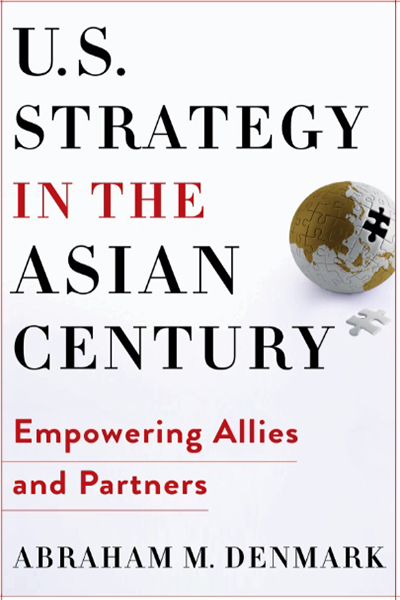
–Résumé
As the geopolitical environment has evolved and American interests have changed, Washington’s approach to alliances and partnerships have evolved as well. Since the collapse of the Soviet Union and the Eastern Bloc, NATO has acted to stop genocide in the former Yugoslavia and later augmented the United States’ liberation of Afghanistan after the terrorist attacks of September 11, 2001. In Southeast Asia, the spread of terrorist organizations spurred the United States to revitalize its alliances and partnerships in the region to fight their spread and counter their attacks.
Today, the Indo-Pacific looms as a vital region for American economic, political, and security interests. The region includes the world’s largest economies, representing two-thirds of global growth; it accounts for 60 percent of global gross domestic product; and it is home to some of the world’s largest and most advanced militaries and several of nuclear powers.
The Indo-Pacific’s tremendous strategic importance to the United States, and to the fate of global geopolitics, was the motivating factor behind the Obama administration’s rebalance to the Asia-Pacific and the Trump administration’s strategy to build a free and open Indo-Pacific.
Yet just as this region continues to grow in significance for the United States, the essential dynamics of its geopolitics are in the midst of a fundamental change. China is steadily growing more powerful, and it is becoming increasingly assertive in the pursuit of its objectives. Concurrently, American engagement in the region is seen across the region as both insufficient and unreliable.
This book argues that these changes in the regional balance of power threaten the existing liberal regional order, which has been fundamental to regional stability and prosperity for decades. It also argues that the regional balance of power is no longer only about military capacity, but instead involves multiple measures of national power—including trade and investment flows, economic throw-weight, soft power, and military potential. This book explores how US allies and partners are increasingly adopting hedging strategies to account for these changes, and proposes a strategy for the United States to empower its regional allies and partners to help strengthen these critical relationships and defend the key principles that are the foundation of the liberal regional order.
This book primarily focuses on the need for the United States to empower its key allies and partners in the Indo-Pacific, many of which are focusing more on the role they will play in the emerging regional heterarchy. The scope of this book encompasses the American allies (Australia, Japan, the Philippines, and South Korea) and partners (India, Indonesia, New Zealand, Singapore, Taiwan, and Vietnam) that are most critical for a US strategy in Asia. This is certainly not an exhaustive list, but instead an examination of some of the most critical alliance and partner relationships in the Indo-Pacific. Discussions of Thailand, for instance, are not a major feature of this book—largely because there is little potential for the US–Thai Alliance to substantially change as long as the military government remains in power.
At times, the book also discusses the role that allies and partners outside Asia—and especially in Europe—can play in US strategy in the region. Although other observers may group American allies and partners differently—potentially focusing on treaty allies only, or solely grouping nations based on allies and partners that are democratically governed—this book focuses on allies and partners whose interests in strengthening aspects of a liberal order in Asia align with those of the United States and that are generally comfortable with the United States playing a significant role in the region’s geopolitics.
-CONTENTS
Preface
Introduction: Challenged Friendships in Challenging Times
1-Order and Power in the Indo-Pacific
2-A Region in Flux
3-Empowering US Allies and Partners in the Indo-Pacific
4-Country Studies
Conclusion: Toward an Allied Strategy in the Indo-Pacific
Notes
Selected Bibliography
Index
–caracteristiques
Date de parution : 20ctober, 2020
N.de page : 320 pages
ISBN-10 : 0231197659
ISBN-13 : 978-0231197656
Dimensions : 5.25 x 0.75 x 8.25
édition : Columbia University Press
Langue: English




Reviews
There are no reviews yet.