
Proportionality in International Humanitarian Law: Consequences, Precautions, and Procedures,Amichai Cohen
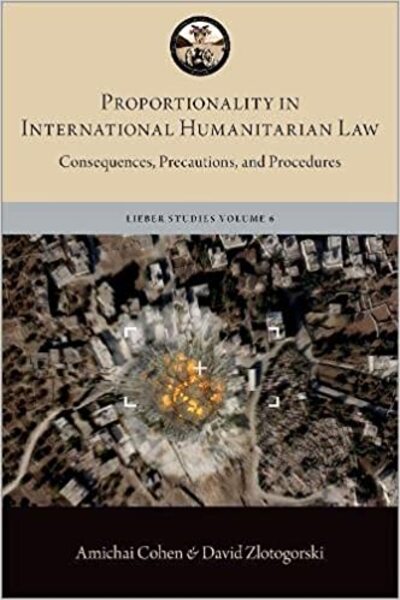
-About this book
The principle of proportionality is one of the corner-stones of international humanitarian law. Almost all states involved in armed conflicts recognize that launching an attack which may cause incidental harm to civilians that exceeds the direct military advantage anticipated from the attack
is prohibited. This prohibition is included in military manuals, taught in professional courses, and accepted as almost axiomatic. And yet, the exact meaning of the principle is vague. Almost every issue, from the most elementary question of how to compare civilian harm and military advantage, to the obligation to employ accurate but expensive weapons, is disputed. Controversy is especially rife regarding asymmetrical conflicts, in which many modern democracies are involved. How exactly should proportionality be implemented when the enemy is not an army, but a non-state-actor embedded within
a civilian population? What does it mean to use precautions in attack, when almost every attack is directed at objects that are used for both military and civilian purposes?
-CONTENTS
Preface xi
Table of Treaties and Cases xiii
PART I: General Concepts
- An Introduction to Proportionality 3
- General Concepts 3
- Legal Sources 8
C.the Structure of the Book 9
- Ethical and Constitutional Foundations 11
A.the Possible Sources for Proportionality 11
- A Philosophical and Religious Prism of Proportionality 12
Premodern Views of Proportionality 12
the Philosophical Background 14
- the Rational Analysis of Proportionality 16
Rational Reciprocal Explanation 16
- Proportionality as a Mode of Control 18
- the Constitutional and Administrative Background to Proportionality
Analysis 21
- A General Overview of Proportionality in IHL 23
- the History and Development of IHL Proportionality 23
- Contemporary IHL and Proportionality 29
- the Changing Nature of Armed Conict and Proportionality 33
Applying Proportionality: Examples and Dilemmas 35
Fighting Non-State Actors and the Application of the Principle of
Proportionality 39
Parallel Application of IHL and International Human Rights Law 44
the Right to Life during Armed Conicts 48
Dierent Balances of IHL/HRL in Dierent Types of Armed
Conflicts? 50
- Conclusion 55
PART II: e Practical Application of Proportionality
- Military Advantage 59
- What Constitutes a Military Advantage? 60
- Military Advantage of an Attack 65
- Incidental Harm and the Analysis of Proportionality 73
- Civilians or All Persons Protected from Attack 73
- What Constitutes Harm? 78
Harm to the Person 78
Economic Damage 80
Civilian Objects 81
Damage to the Natural Environment 81
Benetting from Proportional Harm 83
- Indirect and Reverberating Eects 83
Foreseeable Harm 84
Causality 87
- Level of Expectation/Anticipation 88
- A Balancing Act: What Constitutes a Violation? 92
Dierent Standards in Diferent Conflicts? 99
Excessive vs. Extensive: An Upper Limit to Civilian Harm? 100
- From Whose Perspective Should Proportionality Be Examined? 101
- Soldiers vs. Civilians 107
- the Basic Dilemma 107
B.the Kasher vs. Walzer Debate 108
C.the Lives of Soldiers and Proportionality 110
- the Context of Force Protection 114
E.the Enemy’s Soldiers 117
- Strategic and Cultural Considerations 119
A.the Meaning of “Concrete and Direct Military Advantage” 120
- Policy Arguments Regarding Strategic and Cultural Considerations 121
the Divide between IHL and Laws on the Use of Force 121
An Inherent or Tangible Military Advantage? 122
Uncertainty and Manipulations 123
- Who Bears the Burden of Accommodating a State’s Sensitivities? 125
A Matter of Context? 126
Permitting Less Collateral Damage? 127
- Dierent Requirements for Dierent States? 128
- the Futility of Force, Deterrence, and Proportionality 131
- Direct Participation in Hostilities and Its Eect on Proportionality 135
- the Concept of Direct Participation in Hostilities 135
- the Defnition of Direct Participation in Hostilities 139
- Human Shields and Proportionality 145
A.the Problem of Human Shields 145
- Involuntary Human Shields 147
- Voluntary Human Shields 149
D. Discerning Choice 150
10.the Principle of Distinction and Its Relation to Proportionality 155
A. the Defnition of Military Objectives and Its Relation to
Proportionality 155
B. Indiscriminate Attacks 159
Protection of Cultural Property 165
PART III: Understanding Proportionality
11. the Vagueness of Proportionality 169
A. Experimental Meanings of Proportionality 169
B. the Formula of Proportionality 171
C. Rules of ‑umb 174
D. Inherent Vagueness? 175
12. Procedural Aspects of Proportionality 177
A. the Legal Background 178
B. Procedures 179
C.the Suitable Decision-Maker 181
Doubts 187
D. How Much Intelligence Is Necessary? 189
E. Warnings 194
Roof Knocking 196
F. What Is the Role of Military Legal Advisors? 197
G. Conclusion 199
Creating a Zone of Reasonableness 199
Responsibility and Control 199
Organization and Culture 200
13. Judicial Review and Investigations 201
A. Introduction 201
B. Ex Ante Review 201
C. Ex Post Review: ‑e Problem with the Criminal Approach 203
Criminal Investigations 204
the Problem with Criminal Investigations 205
Should Criminal Prosecutions Be Forsaken? 212
D. Ex Post Assessment: An Alternative to Criminal Trials 214
the Non-Exclusive Nature of the Grave Breaches Regime
under IHL 215
E. the Saleh Shehadeh Targeted Killing 220 - -caractéristiquesDate de parution:29 juillet 2021
Éditeur : OUP USA
Langue : Anglais
NB.de pages : 280 pages
ISBN-10 : 0197556728
ISBN-13 : 978-0197556726
Poids de l’article : 788 g



Reviews
There are no reviews yet.