
The Spymasters: How the CIA Directors Shape History and the Future,Chris Whipple
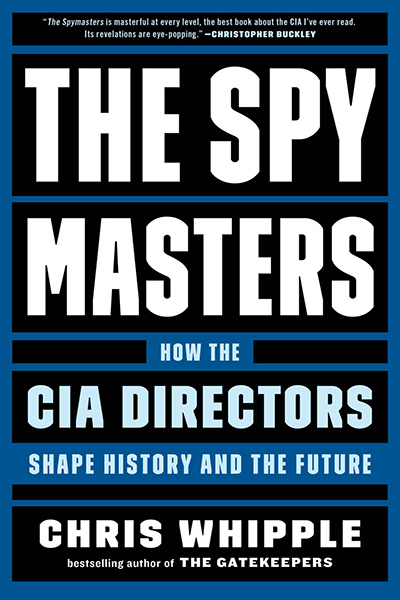
this book provide a thorough and illuminating portrait of America’s CIA directors—based on extensive interviews with the directors themselves—those upon whom the country depends to prevent another 9/11, or even a deadly pandemic , it explore questions such as:
-What’s the proper relationship between the CIA director and the president?
-Should directors obey illegal orders?
-How important is the director’s role as the nation’s honest broker of information during times of crisis?
-How does a Director deal with a President who rejects intelligence that conflicts with his beliefs?
Based on exclusive, unvarnished, and eye-opening interviews with former CIA directors and other top U.S. intelligence officials, including George Tenet, Leon Panetta, John Brennan, and David Petraeus, Chris will answer these questions and more, offering inside stories behind our country’s greatest intelligence coups and blunders.
Since its inception in 1947, the Central Intelligence Agency has been a powerful player on the world stage, operating largely in the shadows to protect American interests. For The Spymasters, Whipple conducted extensive, exclusive interviews with nearly every living CIA director, pulling back the curtain on the world’s elite spy agencies and showing how the CIA partners—or clashes—with counterparts in Britain, France, Germany, Israel, Jordan, Saudi Arabia, and Russia.
Topics covered in the book include attempts by presidents to use the agency for their own ends; simmering problems in the Middle East and Asia; rogue nuclear threats; and cyberwarfare.
For the CIA directors, having the ear of the president is one thing; earning the confidence of the workforce is another. Insular and fiercely tribal, Langley’s denizens can devour outsiders “like white blood cells attacking alien tissue,” said one ex-spy. “It’s like Scottish tribes waiting for the English king,” explained Cofer Black, a legendary operative.
The CIA is a collection of spies, geeks, scientists, technocrats, lawyers, linguists, fixers, and paramilitary warriors. But it consists mainly of two camps: the analysts, of the Directorate of Intelligence (DI), and the operatives, of the Directorate of Operations (DO). They live in such different worlds and speak such different languages that their working areas were once literally walled off and they ate in separate cafeterias.
Analysts tend to be intellectual and introverted (and often sun-deprived). “What’s the difference between an introverted and an extroverted analyst?” goes a joke at Langley. “An extroverted analyst stares at your shoes.” They master such arcana as the throw weight of nuclear missiles, and are expected to decipher enemy war plans, read the minds of foreign leaders, and predict the future. During a legendary forty-year CIA career, Charles Allen, now eighty-three, served many roles, including the National Intelligence Officer (NIO) for Warning, charged with detecting imminent threats. Renowned as the agency’s “Cassandra,” Allen is still haunted by the prediction that got away: his failure to sound a timely warning of the 1973 Arab-Israeli (Yom Kippur) War. “It still bothers you?” I asked him, sitting in his Washington office in the summer of 2018. “Deeply,” he replied. He sighed. “Awful. It’s deep inside me.”
CIA analysts aren’t perfect and they often pay the price. John McLaughlin, a courtly intellectual who served twice as acting director, is also an accomplished magician; on a visit to Moscow he dazzled his Russian intelligence counterparts with feats of sleight of hand, turning a 10,000 ruble note into 100,000. But when McLaughlin and his fellow analysts botch an intelligence estimate—as with Iraq’s WMDs—their mistakes do not magically vanish. “Analysts write things down, venturing assessment and prediction on issues that are contentious, sometimes unknowable,” he said. “They are hanging out there in words that never go away. Very few others in government do that. No one understands any of this.”
CIA operatives are a different breed; brash and outgoing, they practice deception and seduction, enticing strangers to betray their countries,Breaking the laws of foreign countries is their modus operandi. Members of this tribe are dismissive of the pampered life of analysts.



Reviews
There are no reviews yet.